Antimicrobial resistance (AMR) is among the top global health threats today. Emerging evidence estimates that in 2019 roughly 1.27 million deaths were directly attributable to AMR, with another 4.95 million deaths associated with bacterial drug-resistant infections. Africa bears a disproportionate share of this burden. Weak health systems, limited infection prevention and control, and widespread poverty amplify AMR’s human and socio-economic impact across the continent. Yet global funding and policy attention often fail to prioritise the African response at the scale required.
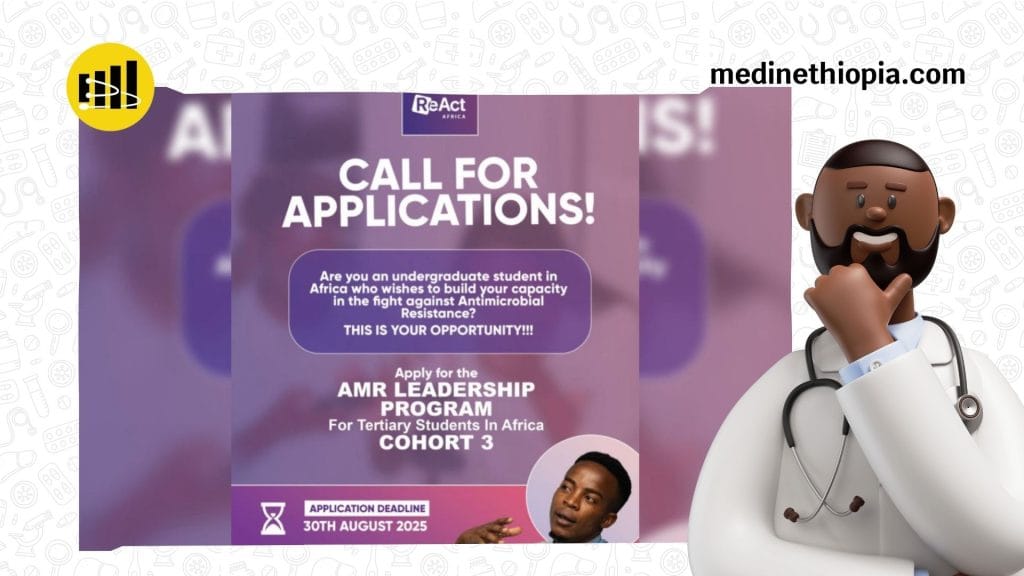
The AMR Leaders Program for Tertiary Students in Africa (AMRLEP), implemented by ReAct Africa in partnership with youth-led organisations, aims to change that by investing in the continent’s greatest asset: its young people. AMRLEP is a six-month, youth-centred capacity-building programme that equips undergraduate tertiary students with practical knowledge, leadership skills and resources to design and lead sustainable AMR interventions on their campuses and in their communities.
What is AMRLEP?
- A six-month hybrid programme (January–June 2025) that combines virtual lectures, webinars, interactive workshops, group coaching, and experiential project work.
- Designed and implemented in collaboration with youth-led organisations to ensure the programme is youth-driven and youth-owned.
- Focuses on a systems approach to AMR—understanding drivers across human health, animal health and the environment (One Health)—and on translating knowledge into feasible, sustainable interventions at institutional and community levels.
- Aims to produce a cadre of informed, motivated AMR champions who can advocate, implement and sustain change within diverse disciplines.
Programme objectives
- Build the capacity of tertiary-level students to mitigate AMR through holistic training, co-creation of interventions, and support for establishing sustainable AMR initiatives at their institutions.
- Stimulate interest and career commitment to AMR mitigation among tertiary students and cultivate AMR champions across disciplines.
- Strengthen youth voices in regional and global AMR dialogues by fostering multidisciplinary collaboration and amplifying youth-led interventions.
Who can apply?
- Undergraduate tertiary-level students (vocational centres, colleges, universities) from any African country.
- Applicants must be 18 years or older at the time of application.
- The programme is open to students from all faculties—health, veterinary, engineering, social sciences, environmental sciences, arts—because the curriculum is designed to be accessible and multidisciplinary.
- Prior experience in AMR is not required; interest, commitment and the ability to engage in team-based project work are the key criteria.
Programme structure and learning methods
- Duration: January–June 2025 (six months).
- Delivery: Hybrid—virtual synchronous lectures and webinars, asynchronous learning modules, facilitated group workshops, iterative co-creation sessions and mentored project implementation.
- Teamwork: Participants work in multidisciplinary teams to design, pilot and document an AMR intervention suitable for their local context (institutional policy, behaviour change campaign, surveillance pilot, WASH intervention, educational module, etc.).
- Mentorship: Each team is paired with expert mentors and peer mentors to guide project design, monitoring and scale-up planning.
- Assessment & certification: Participants complete milestones, submit project deliverables and receive a certificate on successful completion.
Key benefits for participants
- Comprehensive AMR knowledge: A strong grounding in AMR science, drivers and mitigation strategies from a One Health perspective.
- Practical skills: Training in project design, monitoring and evaluation, systems thinking and design thinking.
- Networking: Connections with like-minded peers across Africa and access to subject-matter experts and youth networks.
- Mentorship: Technical guidance from AMR experts and sustained peer mentorship.
- Technical and (when available) financial support: Post-programme technical backing for viable projects; potential access to small grants contingent on availability.
- Teamwork and leadership: Experience working in multidisciplinary teams to deliver a tangible intervention.
- Global perspective: Exposure to international best practices and regional strategies for AMR mitigation.
- Resources and tools: Access to curated research, toolkits and data to support project design and advocacy.
- Recognition: Certificate of completion and a platform to showcase successful interventions.
- Sustainable impact: Skills and institutional links that enable long-term contributions to AMR mitigation in local contexts.
Looking for more scholarships, fellowships, internships, and professional development programmes?
Follow us on Telegram at @medinethiopiainsider
Subscribe to our website : medinethiopia.com
We publish verified opportunities every week tailored for health professionals across Ethiopia
-
Med In Ethiopiahttps://medinethiopia.com/author/fomclb/
-
Med In Ethiopiahttps://medinethiopia.com/author/fomclb/
-
Med In Ethiopiahttps://medinethiopia.com/author/fomclb/
-
Med In Ethiopiahttps://medinethiopia.com/author/fomclb/