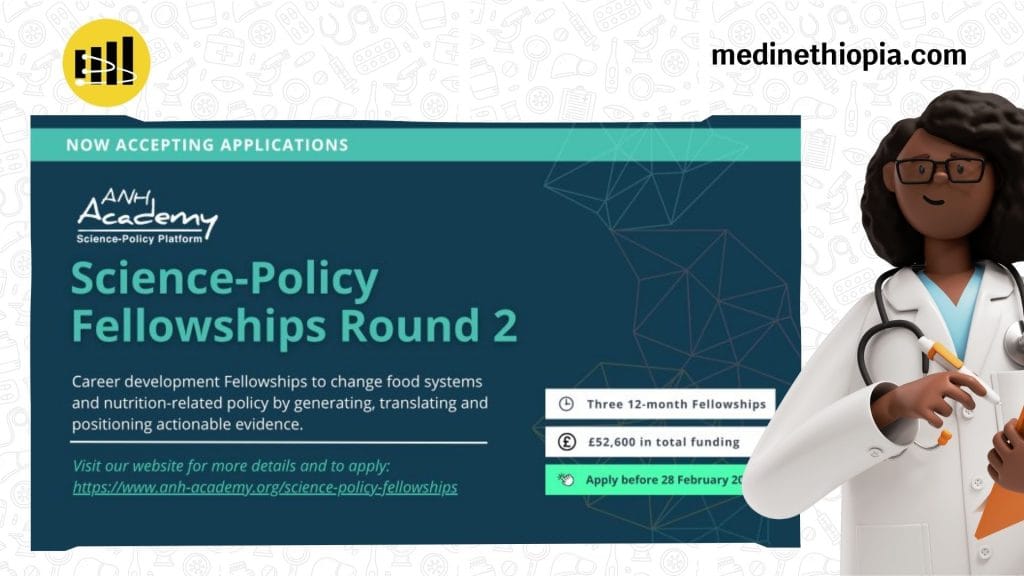
The Agriculture, Nutrition & Health (ANH) Academy, led by the Friedman School of Nutrition Science and Policy at Tufts University, invites proposals for its second round of one-year, full-time Science-Policy Fellowships. The programme funds three twelve-month fellowships focused on translating recent scientific evidence into actionable policy guidance that advances equitable, sustainable increases in the use of healthy diets (and/or reduces food loss and waste) in Sub-Saharan Africa or South Asia.
Purpose and goals
The ANH Science-Policy Fellowships aim to:
- Support evidence-based decisions by using recent, scientifically valid impact assessments, programme evaluations or policy analyses.
- Build researchers’ skills and experience in positioning and translating scientific evidence so that it can guide policies and programmes that increase consumption of safe, affordable, nutritious foods or reduce loss and waste.
- Strengthen local science-policy ecosystems by embedding researchers within policy organisations and fostering mentoring relationships between researchers and decision-makers.
Priority topics
Fellowship projects should focus on one or both of the two main topic areas:
- Demand for healthy diets – actions that affect availability, cost, affordability and food choice.
- Food supply, loss and waste – actions influencing how food flows from production to use, disposal, or non-food uses across the supply chain.
Each project should also address one or both cross-cutting themes:
- Climate change and the environment – climate-resilient food systems and planetary health considerations.
- Equity and gender – actions that advance inclusive food systems and gender-transformative outcomes.
Projects are expected to generate actionable information tailored to decision-makers, using appropriate interdisciplinary methods and data (e.g., quasi-experimental analysis, trials, cost-effectiveness or modelling; pilot or feasibility studies; ethnography; economy-wide analysis).
Fellowship structure, placements and mentorship
- Duration: 12 months full-time (non-renewable). Fellows may begin any time between 1 June and 31 December 2026.
- Policy placement: Fellows must be embedded for a significant fraction of the year (typically at least one third) within a policy organisation physically located in Sub-Saharan Africa or South Asia. Policy placements may be formal advisory roles, membership of task forces/working groups, liaison functions, or other arrangements that enable research to inform specific policy decisions.
- Mentors: Each Fellow must work under joint supervision of a Research Mentor (usually a senior scholar familiar with the applicant’s work) and a Policy Mentor (a senior official in the policy organisation who ensures decision-making relevance). The Research Mentor may be based anywhere; the Policy Mentor must be located in the policy organisation’s country/region.
Funding and other support
Each Fellowship award provides:
- Fellow stipend: £43,000 per year (paid quarterly against milestones).
- Expense allowance: £9,600 (one lump sum to cover travel and costs associated with the policy placement).
- Mentor honoraria: £2,100 to each Mentor (paid in two instalments on mid-term and final mentorship reports).
- Fellows receive online access to Tufts University library resources and any necessary software tools. Additional costs or resources must be secured by the Fellow (from their funds) or arranged in kind.
Expected outputs and impacts
By the end of the Fellowship year, Fellows are expected to complete:
- Quarterly activity reports.
- At least one research article suitable for international peer-review publication.
- At least one policy briefing directed to government decision-makers, to be published on the ANH Academy website.
- At least one policy dialogue with decision-makers and stakeholders, presenting results in actionable form.
- At least one presentation at ANH Academy Week or an ANH Academy event.
The overarching outcome is that the policy organisation uses more robust, relevant evidence for decisions and that the Fellow strengthens skills in evidence translation and policy engagement.
Who is eligible
- Applicants must hold a doctoral or terminal degree (PhD, DPhil, DPH, MD, DVM or similar) in a field related to agriculture, nutrition or health and be actively engaged in interdisciplinary research at the intersection of these fields.
- Applicants may be of any nationality and may have earned their doctorate anywhere, but the programme particularly encourages applicants from Sub-Saharan Africa and South Asia (including candidates who would return home for the policy placement).
- Applicants must propose both a Research Mentor and a Policy Mentor and must present a realistic plan for the policy placement and embedding within the policy organisation.
Application process
- Submission portal: Applications must be submitted via the ANH Academy online portal at anh-academy.org. Questions may be sent to anhfellowships@tufts.edu.
- Deadline: 28 February 2026, 11:59 PM EST (full proposals and letters of support must be received by this deadline).
- Key submission components (summary):
-
- Applicant and mentor contact details.
- Fellowship proposal (maximum 5,000 words, plus references and any tables/figures). The proposal must include: title; abstract; description of the policy/program/intervention to be analysed; expected outcomes and impacts; prior work and data/methods; plan for translating evidence into decision making during the Fellowship year; details of policy placement; mentorship and institutional context; career trajectory; and timeline and logistics.
- Curriculum vitae (three separate CVs for Applicant, Research Mentor, Policy Mentor).
- Two letters of support (one from the Research Mentor and one from the Policy Mentor). Each letter should be no more than two pages and must be submitted by the deadline. The Policy Mentor’s letter should describe the organisation’s commitment and the proposed placement arrangement.
- Contact details for one additional reference (no letter required at submission).
-
Applicants should plan to recruit Mentors and obtain letters well in advance; the Fellowship year is too short to begin projects from a standing start, so proposals must build on prior analyses or evaluations.
Proposal format and guidance
Proposals must not exceed 5,000 words (excluding references and tables/figures). Indicative word guidance is provided in the application instructions for each section (e.g., ~500 words for policy description, ~1,500 words for the plan to bring evidence into decision making). Titles should be concise and informative (examples are provided in the Call for Applications).
Timeline
- Full proposals due: 28 February 2026 (11:59 PM EST).
- Notification of selection: no later than 15 April 2026.
- Fellowships start window: any time between 1 June and 31 December 2026.
- Fellowship duration: 12 months (concludes no later than the chosen start date + 12 months).
Review and selection
Applications undergo a competitive review process using assessment criteria that evaluate: scientific quality and feasibility, relevance to policy priorities, strength and realism of the policy placement and mentorship, the applicant’s track record, and potential for impact. The Call for Applications provides an expanded list of assessment items and a Frequently Asked Questions section to guide applicants.
Further information and enquiries
- Enquiries: anhfellowships@tufts.edu
- ANH Academy held an online information session which is available here.
Looking for more scholarships, fellowships, internships, and professional development programmes?
Follow us on Telegram at @medinethiopiainsider
Subscribe to our website : Subscribe
We publish verified opportunities every week tailored for health professionals across Ethiopia.
-
Med In Ethiopiahttps://medinethiopia.com/author/fomclb/

-
Med In Ethiopiahttps://medinethiopia.com/author/fomclb/

-
Med In Ethiopiahttps://medinethiopia.com/author/fomclb/

-
Med In Ethiopiahttps://medinethiopia.com/author/fomclb/