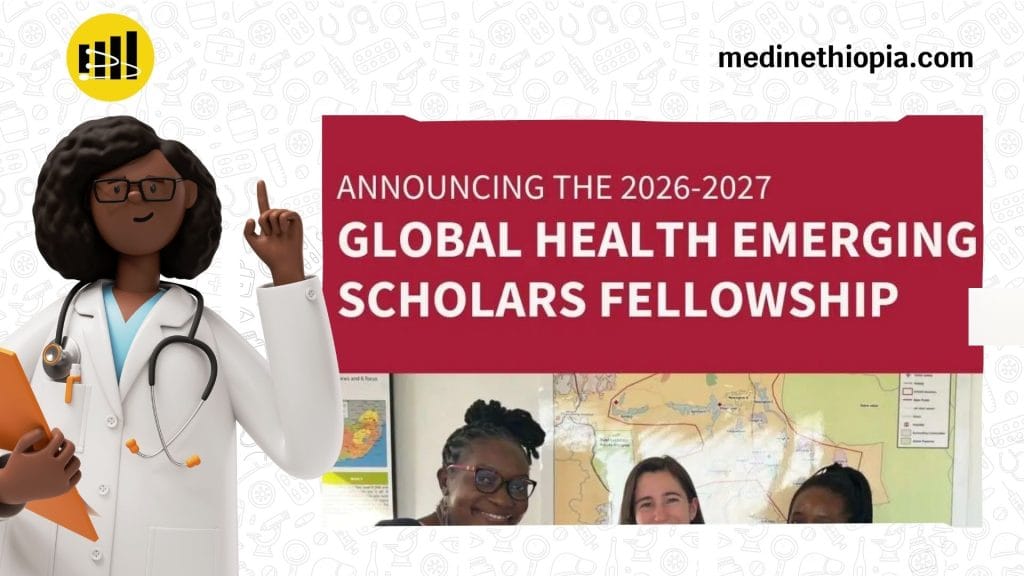
The Global Health Emerging Scholars (GHES) Fellowship is a 12-month, NIH-supported, mentored training programme in global health research. It combines online epidemiology and biostatistics coursework with a full-time practicum at a collaborating LMIC institution, equipping emerging leaders to design and implement impactful public-health interventions.
What Does GHES Provide?
Dual Mentorship
– A primary U.S. mentor (faculty at Yale, Stanford, UC Berkeley, or University of Arizona)
– A primary LMIC mentor at your host site (e.g. Addis Ababa Hospital Research Centre)
Online Training
Asynchronous modules in biostatistics and epidemiology, tailored for global-health researchers.
In-Country Practicum
Ten to twelve months embedded at Addis Ababa University’s research centre, working on locally relevant projects.
Networking & Career Development
Orientation at NIH, connection to Yale’s global alumni network, and formal certification upon completion.
Who Is Eligible?
LMIC (Low- and Middle-Income Country) Post-doctoral Applicants:
-Must hold a doctoral or health-professional degree (PhD, MD, MBChB, DrPH, etc.) conferred within the last five years.
-Be a citizen of Ethiopia and affiliated with Addis Ababa University (or another GHES partner institution in Ethiopia).
-Secure letters of support from one GHES U.S. mentor and one GHES LMIC mentor before applying.
-Commit to 100 % time on fellowship activities for 10–12 months and attend the 5-day NIH orientation in July.
Mentorship Requirement
Each applicant must identify:
-
A primary U.S. mentor—a GHES-designated faculty member at Yale University, Stanford University, University of California Berkeley, or University of Arizona.
-
A primary Ethiopian mentor—a GHES-designated faculty member at the collaborating LMIC research site.
Additional mentors may be proposed, but one primary U.S. and one primary LMIC mentor are mandatory.
How to Apply
-Review Eligibility and Requirements
Confirm doctoral credentials, institutional affiliation, and mentorship commitments.
-Select Research Area
Align with GHES priority topics: chronic and non-communicable diseases; HIV/STIs and other infectious diseases; environmental health; maternal and child health; injuries and trauma; mental health; health-systems research.
-Choose Research Training Site
For Ethiopia, the designated site is the Addis Ababa Hospital Research Centre at Addis Ababa University.
-Obtain Mentor Support
Secure formal letters of support from the chosen U.S. and Ethiopian mentors.
-Submit Online Application
Complete and submit the GHES online application by 1 October 2025, including all required materials.
Application Content
The online form comprises:
-Introduction (programme overview)
-Section 1: Eligibility (degree status, affiliation, previous funding)
-Section 2: Personal & Contact Information
-Section 3: Professional Background (research experience, publications)
-Section 4: Fellowship Details (site choice, training plan, IRB status)
-Section 5: Research Proposal & Supplemental Materials
Required Documents
-Research Proposal formatted per GHES guidelines.
-Letters of Recommendation (minimum two, maximum three) on institutional letterhead, signed by:
The GHES U.S. mentor
The GHES Ethiopian mentor
-NIH biosketch (for applicant)
Upload your NIH biosketch using the FELLOWSHIP biosketch format. For instructions on how to format your biosketch, please refer to NIH guidelines of a FELLOWSHIP biosketch. It is strongly suggested to have a mentor review your biosketch if this is your first time generating one.
-NIH biosketch (for mentors)
Upload the NIH biosketches for your U.S. and LMIC mentors, using the NON-FELLOWSHIP biosketch format
Timeline
Now – 1 Oct 2025: Submit online application
Oct–Nov 2025: Eligibility & committee review
Dec 2025–Feb 2026: Interviews (if needed) & reference verification
Apr–Jun 2026: Fellowship awards announced
Jul 2026: NIH orientation (Bethesda, MD)
Aug 2026–Jul 2027: Practicum at AAU
Ethiopia Research Training Site
Addis Ababa Hospital Research Centre (AAHR), Addis Ababa University
-
Surgical Safety & Quality Improvement: Home of the Clean-Cut programme and SALTS initiative partnership with Stanford.
-
Health Systems Research: Robust MEPI/HEPI-funded infrastructure for faculty development and methodology training.
-
Focus Areas: trauma care curricula, perioperative standards, anesthesia, and emergency-care quality improvement—building Ethiopia’s leadership in surgical health.
Selection Process
-
External Review: scored on research aptitude, proposal quality, career vision, mentorship plan, and fellow potential
-
Interviews: by Yale and AAU faculty as needed
-
Final Decisions: made by the GHES executive committee; offers in April–June 2026
Ethiopia Site Details
– Site: Addis Ababa University
-Stanford University Mentor: Dr. Tom Weiser
-Addis Ababa University Mentors: Drs. Miliard Derbew and Tihitena Negussie Mammo
Looking for more scholarships, fellowships, internships, and professional development programmes?
Follow us on Telegram at @medinethiopiainsider
Subscribe to our website : medinethiopia.com
We publish verified opportunities every week tailored for health professionals across Ethiopia
-
Med In Ethiopiahttps://medinethiopia.com/author/fomclb/
-
Med In Ethiopiahttps://medinethiopia.com/author/fomclb/

-
Med In Ethiopiahttps://medinethiopia.com/author/fomclb/
-
Med In Ethiopiahttps://medinethiopia.com/author/fomclb/