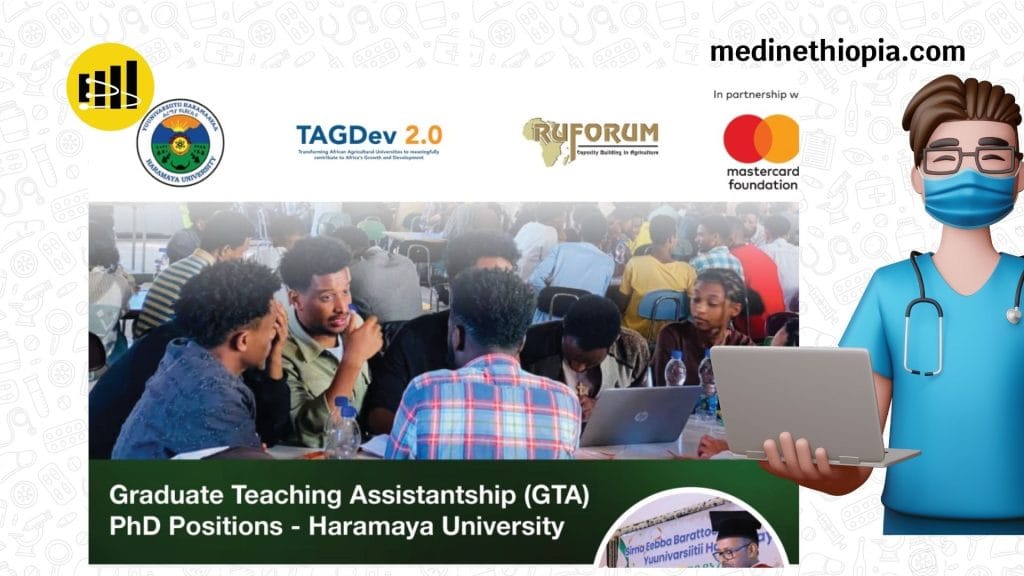
Haramaya University, in partnership with the Regional Universities Forum for Capacity Building in Agriculture (RUFORUM) and the Mastercard Foundation, is accepting applications for 25 Graduate Teaching Assistantship (GTA) PhD positions for the 2025/26 academic year. These positions are offered under the Transforming African Agricultural Universities to Meaningfully Contribute to Africa’s Growth and Development (TAGDev 2.0) programme, a 10‑year initiative (2023–2033) designed to strengthen agricultural higher education and empower economically disadvantaged, academically talented young Africans.
Programme Partners
TAGDev 2.0 brings together seventeen African universities across East, West, Central, and Southern Africa, including Gulu University (Uganda), Egerton University (Kenya), Africa University (Zimbabwe), University of the Free State (South Africa), and others. Haramaya University participates through its Agri‑food Systems and Entrepreneurship Center (ASEC), focusing on horticulture value chains (fruit and vegetable systems) in Ethiopia.
Graduate Teaching Assistantship (GTA) Objectives
The GTA scheme aligns with RUFORUM’s strategic goal to develop quality human resources for intensifying Africa’s agricultural productivity and competitiveness. Since 2015, the GTA programme has:
– Enhanced higher‑education quality and increased the pool of PhD‑qualified academic staff.
– Encouraged doctoral research to address African development challenges directly.
– Strengthened inter‑university collaboration and staff mobility among RUFORUM members.
Roles and Responsibilities
Selected GTA Fellows will:
– Assist in undergraduate teaching duties at Haramaya University under a tripartite agreement with their home institutions.
– Conduct community‑based action research within the TAGDev 2.0 horticulture project, especially across potato and allied value chains.
– Participate in multi‑disciplinary mentorship and receive co‑supervision from Haramaya University and partner institutions.
– Engage in data collection, stakeholder engagement, value‑chain analysis, and participatory rural appraisal.
– Attend specialised courses in academic writing, soft skills, systematic reviews, data analysis, and present findings at local and RUFORUM events.
Scholarship Benefits
Each GTA Fellow will receive:
– Tuition waiver and accommodation at Haramaya University.
– Modest monthly upkeep and research funds.
– Health insurance and travel support (covered by the sending university).
– Access to team‑based supervision by senior academics and industry experts.
– Opportunities to present research outcomes at conferences and a RUFORUM graduation event.
Eligibility Criteria
Applicants must:
– Be staff or PhD candidates from RUFORUM member universities, including Ethiopian institutions (Haramaya, Wollo, Mekelle, Jimma, Bahir Dar, Aksum) and select partners outside Ethiopia (Bugema, University of Liberia, University of Ndjamena).
– Hold a background in agriculture or related fields (e.g., horticultural sciences, agribusiness/value chains, climate‑smart agriculture, food sciences, soil sciences, agroecology, nutrition–health nexus, agri‑information sciences).
– Have completed PhD coursework, successfully defended a proposal aligned with TAGDev priorities, or be ready to commence data collection (for current Haramaya University candidates).
– Demonstrate academic excellence and financial need (self‑funded or institutionally sponsored candidates not eligible).
– Commit to reside at Haramaya University for the full duration (up to 36 months).
– Provide a concept note on their proposed research aligned with one of the thematic areas below.
– Submit endorsement and nomination letters from their supervisor, department, and university leadership.
– Be under 40 years of age on the application deadline.
Note: At least 70% of the GTA positions will be allocated to women. Applicants with disabilities, refugees, and those from conflict‑affected areas are strongly encouraged to apply.
Thematic Research Areas
Fellows’ research must address one of the following themes within potato and allied value chains:
1. Technology Identification, Development, and Scaling
-Mapping and testing climate‑smart TIMPs (Technologies, Innovations, Management Practices)
-ICT integration in agriculture
2. Sustainable and Integrated Farming Systems
– Integrated livestock‑horticulture systems
– Soil fertility management and water resources
– Integrated pest management and nature‑based solutions
3.Value Chain and Market Systems
– Post‑harvest management and decentralized learning systems (DLS)
– Community seed systems and agribusiness management
4.Socioeconomic and Institutional Dimensions
-Impact assessments of TIMP adoption on food security, income, scaling
-Youth agripreneurship and innovation platforms
-Role of indigenous knowledge and institutions in technology uptake
5.Cross‑Cutting Themes
-Gender, youth, climate change, nutrition–health nexus
Nutrition–Health Nexus Section
The nutrition–health nexus emphasizes the critical interdependence between dietary quality and health outcomes. GTA Fellows focusing on this theme will:
-Investigate how horticultural innovations influence dietary diversity, micronutrient intake, and the prevention of malnutrition and non‑communicable diseases.
-Develop community interventions that link local food production improvements with nutrition education and health monitoring.
-Evaluate the impact of value‑chain enhancements on household food security, nutritional status, and broader health indicators.
-Collaborate with public health professionals to integrate agriculture‑based solutions into local health systems, ensuring that increased agricultural productivity translates into tangible health benefits.
Applicants must align their concept note and research proposal with one of these priority areas.
Selection Process
A Project Steering Committee (PSC), in consultation with the Student Recruitment and Selection Committee, will evaluate applications based on:
-Academic background relevance
-Quality and alignment of the research concept note
– Completeness of application documents (CV, transcripts, certificates)
– Research/work experience and publications
– Letters of recommendation and institutional endorsements
– Evidence of financial need
– Commitment to complete the 36‑month programme
– Final award decisions rest with the PSC, which will follow affirmative‑action guidelines favoring women, persons with disabilities, economically disadvantaged candidates, and those from conflict zones—without compromising academic excellence.
Application Procedure
Interested candidates should submit all documents (compiled into a single PDF) by 15 August 2025 to:
Dr. Getachew Shambel, TAGDev 2.0 Coordinator, Haramaya University (getachew.shambel@haramaya.edu.et)
Ms. Selma Nghituwamhata, RUFORUM (s.nghituwamhata@ruforum.org)
Subject Line: Application for Graduate Teaching Assistantship under TAGDev 2.0
Required Documents:
– Motivation letter outlining research interests and suitability
– Detailed CV
– Certified academic transcripts and degree certificates
– Research proposal (max. 10 pages)
– Nomination letter from the President/Vice Chancellor/Rector of home university
– Endorsement letters from supervisor, department/school, and academic vice‑president/Deputy Vice Chancellor/Vice Rector
– List and copies of up to two relevant academic publications
– Two recommendation letters with referee contact information
Contact Information
For inquiries, please contact:
Dr. Getachew Shambel (getachew.shambel@haramaya.edu.et)
Ms. Selma Nghituwamhata (s.nghituwamhata@ruforum.org)
Females, refugees, internally displaced persons, and persons with disabilities are particularly encouraged to apply.
Looking for more scholarships, fellowships, internships, and professional development programmes?
Follow us on Telegram at @medinethiopiainsider
Subscribe to our website : medinethiopia.com
We publish verified opportunities every week tailored for health professionals across Ethiopia.
-
Med In Ethiopiahttps://medinethiopia.com/author/fomclb/

-
Med In Ethiopiahttps://medinethiopia.com/author/fomclb/

-
Med In Ethiopiahttps://medinethiopia.com/author/fomclb/

-
Med In Ethiopiahttps://medinethiopia.com/author/fomclb/