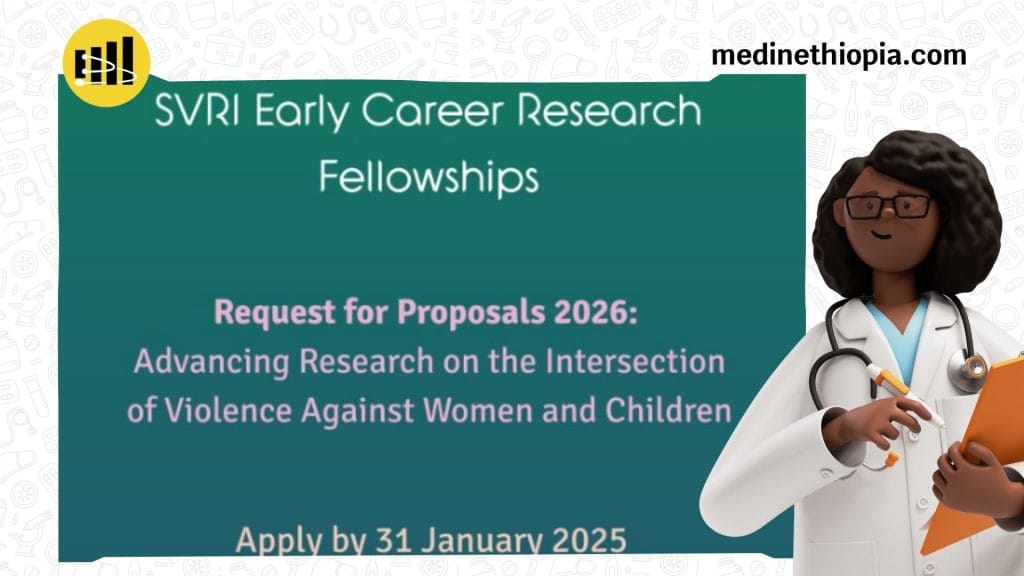
The Sexual Violence Research Initiative (SVRI) announces a competitive fellowship scheme for early career researchers in low- and middle-income countries (LMICs) whose doctoral or post-doctoral work focuses on the intersections between violence against women (VAW) and violence against children (VAC). The fellowships aim to strengthen locally led evidence, build research leadership and support dissemination of context-relevant findings that can inform prevention and response in LMIC settings.
Background
Recognition is growing that VAW and VAC are deeply connected—sharing risk factors, social norms, co-occurrence within households, intergenerational impacts and compounding life-course consequences. However, evidence remains fragmented: measurements and definitions vary, longitudinal and gender-analytical studies are limited, and few interventions have been rigorously evaluated across both forms of violence. SVRI’s Early Career Research (ECR) Fellowships invest in LMIC-based researchers to fill these gaps and produce locally relevant, feminist and equity-driven research.
Fellowship purpose & objectives
The SVRI ECR Fellowships seek to:
- Strengthen the evidence base on intersections between VAW and VAC.
- Build leadership and research capacity among early career researchers in LMICs.
- Support publication and dissemination of locally generated knowledge.
- Foster regional and global networks of feminist, equity-driven researchers.
Available awards
- Doctoral Fellowships: 2 awards – up to USD 17,000 per year (up to 2 years).
- Postdoctoral Fellowships: 2 awards – up to USD 20,500 per year (up to 2 years).
Fellowship funds are intended to cover direct research costs, a one-week academic site visit and attendance at one international conference, and may include up to 15% overhead. Budgets must not exceed the stated ceilings; proposals exceeding limits will be rejected. (South African applicants must submit budgets in ZAR.)
Who may apply
Applicants must meet all of the following:
- Be a national of an LMIC (World Bank classification).
- Be enrolled full-time at an accredited, in-person academic institution in an LMIC.
- Be conducting a PhD dissertation or postdoctoral research focused on intersections of VAW and VAC.
- PhD applicants must have a defended or institutionally approved dissertation proposal.
Preference will be given to candidates from under-represented regions or groups and to those demonstrating long-term commitment to advancing the rights and wellbeing of women and children.
Application process & required documents
All applications must be submitted online via Proposal Central:
https://proposalcentral.altum.com (Search under Award Maker: Sexual Violence Research Initiative). First-time users must register.
Languages accepted: English, French or Spanish.
Application components (form + uploads):
- Online form including:
-
- Career Objectives – 6,000 characters (describe long-term goals and how the fellowship will help).
- Community Impact Statement – 3,000 characters (describe how the work will improve lives and safety of women and girls; note engagement with boys, men or community where relevant).
- Research Proposal – submitted following SVRI format (see below for form sections and character limits).
2. Uploads:
-
- Letter from academic institution verifying enrolment status and nationality.
- Academic transcripts (past two years).
- Two reference letters (one preferably from the academic advisor).
- Full research proposal file (if requested in addition to form fields).
Research proposal (form sections and limits – characters include spaces):
- Applicant & institution details.
- Abstract: 3,000 characters.
- Project background & literature summary: 6,000 characters (reference list may be uploaded).
- Innovation & contribution: 3,000 characters.
- Research aim & objectives: 3,000 characters (maximum 4 objectives).
- Research methods: 6,000 characters (design, site, population, sampling, analysis; intervention detail where relevant).
- Data management plan: 2,500 characters.
- Research plan (activities to achieve aims/objectives): 8,000 characters.
- Ethical considerations: 6,000 characters (state whether approval is secured, pending, or will be sought).
- Timeline: realistic schedule covering 24 months.
- Budget & justification: definitive line-item budget; overhead ≤15%; include costs for one-week academic visit and one conference.
Important application constraints:
- Applicants may submit only one proposal.
- South African applicants must submit budgets in ZAR; other applicants must submit budgets in USD.
- Ethical approval need not be in hand at submission, but fellowships will only be awarded once ethical clearance is obtained. Applicants must state the ethics status and plan.
Selection process
SVRI will follow a two-step selection process:
- Expert review panel assesses applications against criteria (scientific merit, relevance to VAW/VAC intersections, feasibility, institutional support and value for LMIC contexts).
- Panel interviews with shortlisted applicants. Final fellowship winners will be selected after interviews.
Shortlisted candidates will be invited to a panel interview; final decisions will be communicated thereafter.
Key dates & submission deadline
- Deadline for applications: 31 January 2026 at 11:50 pm South African Time (SAST).
- Late or incomplete applications or proposals submitted outside Proposal Central will not be accepted. Applicants are encouraged to submit early to avoid technical issues.
Budget guidance & allowed costs
- Budgets must be definitive line-item budgets for direct research costs, travel for data collection, software, publication costs, books, and the required academic site visit and conference attendance.
- Overhead/indirect costs must not exceed 15% of total direct costs.
- Applications exceeding the specified ceilings will be rejected.
- If unsure, applicants should budget conservatively and justify each line item clearly.
Ethics & research governance
- All SVRI-funded research must obtain ethical approval before award activation. Applicants should state current ethics status and which committee will review the study.
- Applications should clearly outline how ethical risks will be mitigated (confidentiality, referral pathways, safeguarding, informed consent, data security).
Frequently asked questions
- Can applicants from high-income countries apply if enrolled in an LMIC? No, applicants must be nationals of an LMIC and based at an LMIC institution.
- Are applications accepted in languages other than English? Yes , English, French or Spanish are accepted.
- Is ethical approval required at submission? Not necessarily; applicants must state whether approval is granted, pending, or will be sought. Awards are conditional on obtaining clearance.
- Can applicants submit more than one proposal? No, one proposal per applicant.
- What happens if a fellow changes topic or university? Fellows become ineligible if they drop out, change to an unrelated topic, or leave their institution during the fellowship period.
- Will SVRI cover university administrative fees? SVRI covers up to 15% indirect costs; additional university fees beyond indirect costs are not covered.
- Are supervisors’ time or fees covered? No, the fellowship supports the fellow’s research time and costs, not advisor fees.
- What currency should be used for budgets? South African applicants: ZAR. All others: USD.
For other FAQs, applicants should consult the full call and contact SVRI.
Contact & further information
- Enquiries: svri@svri.org ( use subject line: “Fellowships”)
- Application deadline: 31 January 2026, 11:50 pm SAST
Looking for more scholarships, fellowships, internships, and professional development programmes?
Follow us on Telegram at @medinethiopiainsider
Subscribe to our website : medinethiopia.com
We publish verified opportunities every week tailored for health professionals across Ethiopia.
-
Med In Ethiopiahttps://medinethiopia.com/author/fomclb/

-
Med In Ethiopiahttps://medinethiopia.com/author/fomclb/

-
Med In Ethiopiahttps://medinethiopia.com/author/fomclb/
-
Med In Ethiopiahttps://medinethiopia.com/author/fomclb/