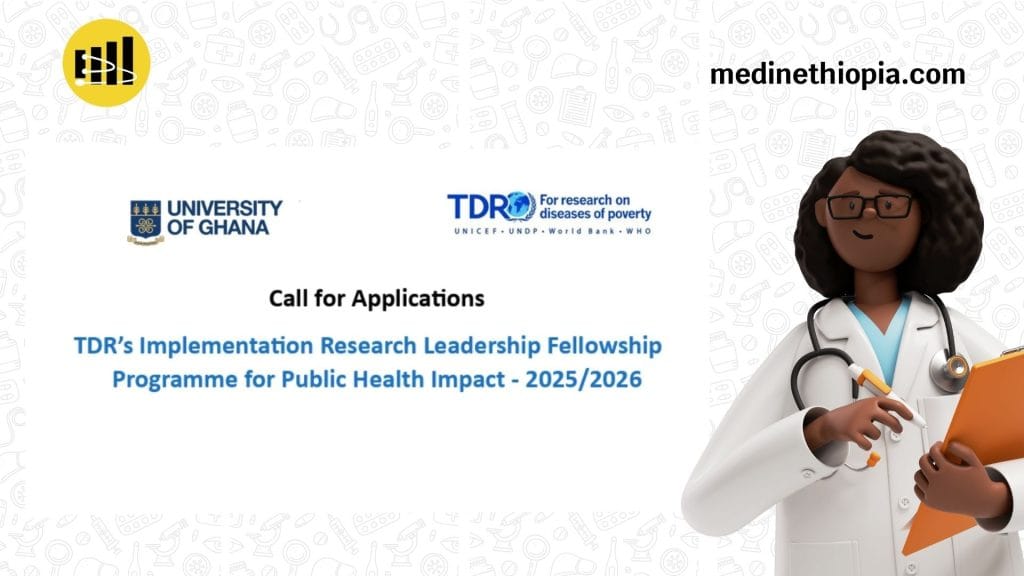
The School of Public Health at the University of Ghana, in partnership with TDR (Special Programme for Research and Training in Tropical Diseases) and co-sponsors UNICEF, UNDP, the World Bank and WHO, invites applications for the Implementation Research Leadership Fellowship Programme for Public Health Impact for the 2025/2026 academic year. The fellowship is intended to build a network of LMIC-based IR leaders who can design and lead implementation research that improves health policy and practice across the WHO Africa Region.
Programme purpose and objectives
The fellowship aims to:
- develop professional and innovative leadership in implementation research (IR);
- strengthen the capacity of public-health institutions to generate and apply IR evidence for improved health outcomes;
- establish a collaborative network of IR leaders in LMICs who contribute to policy and practice at local, regional and global levels.
The programme targets four priority challenges identified in the TDR Strategy 2024–2029:
- control and elimination of infectious diseases of poverty;
- resistance to treatment and control agents (AMR);
- epidemics and outbreaks;
- and the health impacts of climate change — all addressed through an integrated (One Health) approach.
Fellowship format and duration
- Location: University of Ghana School of Public Health (in-person; English).
- Start (expected): January 2026.
- Duration: up to 6 months for programme implementers; up to 12 months for academics/researchers.
Fellows will receive leadership training in IR, experience in stakeholder engagement and collaboration, and opportunities to lead the design of large-scale IR interventions and drive knowledge translation and policy engagement.
Who is eligible
Mandatory requirements
Applicants must:
- be nationals and residents of a low- or middle-income country in the WHO Africa Region
- be under 40 years old at the time of application;
- be employed by a university, research institution, ministry of health, public health institution, or an NGO with a registered legal entity in Africa;
- demonstrate interest in an academic or public-health leadership career in IR addressing the fellowship focus areas (One Health-oriented);
- be proficient in English (the programme is delivered in English; the applicant’s Bachelor’s degree must have been completed in English);
- be able to obtain study leave from current employment;
- consent to meet host-country health requirements.
Academic & experience requirements
Applicants should ordinarily:
- be graduates of the TDR MPH/MSc in Public Health/IR programme or hold a similar MSc with a focus on implementation research;
- have 3–5 years of post-Master’s experience in academia or the health system.
Desirable (but not mandatory)
- a PhD in health systems or IR; or
- a medical degree with five years’ experience in IR, health systems research or programme implementation;
- at least one peer-reviewed article on an IR theme published in an open-access journal;
- experience with systematic or scoping literature reviews and interdisciplinary projects.
TDR is explicitly committed to equality, diversity and inclusivity and encourages candidates from all backgrounds to apply.
Fellowship package (what is covered)
The fellowship provides a support package to enable in-country participation and research activities:
- return economy airfare between fellow’s home country and Accra, Ghana;
- basic medical and accident insurance;
- support for approved fieldwork and research-related activities during the fellowship;
- a monthly stipend to cover living expenses (aligned to local cost of living in Ghana);
- travel and accommodation for specific training, international exposure, conferences and networking.
Note: Fellows must secure study leave from their employer and meet host-country health regulations.
Examples of fellowship activities
Fellows can expect to engage in a mix of applied and leadership activities, for example:
- co-designing and leading large-scale IR projects;
- participating in leadership development workshops and seminars;
- contributing to and delivering courses within the MPH or PhD programmes at the School of Public Health;
- conducting and publishing IR work (peer-reviewed paper) and preparing project reports;
- knowledge translation and stakeholder engagement to influence policy.
How to apply & required documents
Applicants must complete the TDR IR Leadership Programme application form and submit materials by email to tdrscholarship@ug.edu.gh. Required attachments:
- One-page motivation letter for the IR Leadership Programme (concise).
- Implementation research (IR) proposal — maximum 5 pages including references.
- Curriculum vitae (CV) including a list of peer-reviewed publications.
- Two letters of reference on official letterhead.
Please complete the TDR IR Leadership Programme application form and email it to tdrscholarship@ug.edu.gh
Key dates
- Call launch: 15 August 2025
- Application deadline: 29 September 2025 — 17:00 GMT
- Selection results announced: 7 November 2025
For enquiries, applicants may contact the TDR Postgraduate Training Scheme Secretariat at the University of Ghana School of Public Health:
-
WhatsApp / Mobile: +233 55 4359 139
-
Email: tdrscholarship@ug.edu.gh
Looking for more scholarships, fellowships, internships, and professional development programmes?
Follow us on Telegram at @medinethiopiainsider
Subscribe to our website : medinethiopia.com
We publish verified opportunities every week tailored for health professionals across Ethiopia
-
Med In Ethiopiahttps://medinethiopia.com/author/fomclb/
-
Med In Ethiopiahttps://medinethiopia.com/author/fomclb/

-
Med In Ethiopiahttps://medinethiopia.com/author/fomclb/
-
Med In Ethiopiahttps://medinethiopia.com/author/fomclb/