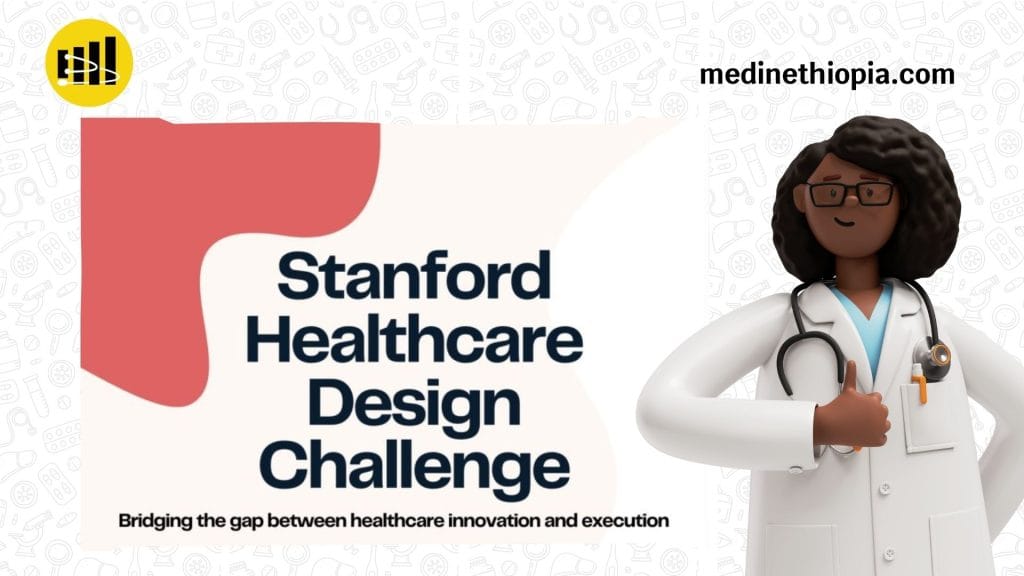
The Stanford Healthcare Design Challenge (SHDC) invites currently enrolled undergraduate and graduate students worldwide to design practical, scalable solutions for urgent health problems. Hosted by Stanford University, the competition bridges innovation and implementation by combining open learning, senior mentorship, industry input and post-competition support to help promising ideas survive beyond the pitch stage.
The problem SHDC addresses
Healthcare problems are inherently complex and multidisciplinary: they involve patients, providers, payers, policymakers and many others. Promising ideas frequently fail to progress from concept to implementation because they lack real-world feasibility, multidisciplinary input, or follow-on support. SHDC seeks to reverse that trend by focusing effort and resources on the most viable student-led solutions.
The SHDC approach (solution)
SHDC is designed as a first-of-its-kind, democratized model for an academic health-design competition. Its objective is twofold:
- widen access to practical knowledge about healthcare innovation through an open-learning series, and
- provide implementation-focused support (mentorship, technical lectures, and industry connections) so teams can refine and scale their concepts.
Selected teams receive expert-led instruction, intensive mentorship and industry feedback to move from prototype to market-ready solution.
How the competition works | The model
SHDC combines a virtual competition format with staged learning and implementation support:
- Open-learning series (September): democratizes foundational knowledge on healthcare innovation for all registrants.
- Mentorship: teams are paired with experienced mentors, including senior executives and C-suite professionals, who provide stakeholder perspectives.
- Industry input: judges include senior decision-makers from government, health systems, payers and non-profits to ensure real-world relevance.
- Intensive refinement: selected teams undergo two weeks of expert-led lectures and mentorship across domains such as legal services, regulation, software design, clinical needs finding and pitching.
- Post-competition support: winning teams receive stipends for customer discovery and go-to-market activities, an advisory board of senior mentors, access to partner perks, and ongoing implementation support.
2025 challenge theme
This year’s brief invites teams to:
Design a financially sustainable and scalable healthcare solution for populations experiencing geographic transitions, including refugees, victims of natural disasters, seasonal workers, displaced persons or other groups navigating voluntary or involuntary migration, within or across national borders.
What the jury will look for
- Innovative, evidence-informed ideas with clear feasibility
- A plausible plan for collaboration and implementation (partners, timelines, roles)
- Demonstrable metrics to measure potential impact and scalability
Who may apply
- Currently enrolled undergraduate or graduate students anywhere in the world.
- Students who will matriculate into an undergraduate or graduate program by the end of 2025 are also eligible.
- Teams are encouraged to be multidisciplinary and to combine clinical, technical, policy and business skills where possible.
Benefits and support for teams
- Access to Stanford-led educational materials and open-learning resources.
- One-on-one and group mentorship from senior healthcare and industry leaders.
- Two-week intensive lecture and mentorship sprint on legal, regulatory, technical and pitching skills for selected teams.
- Financial stipends for customer discovery and market testing awarded to winners.
- Ongoing advisory support and partner perks aimed at enabling implementation beyond the competition.
Timeline & key date
- Application / Interest form deadline: September 22, 2025 , 11:59 PM Pacific Time.
(Teams should ensure submissions comply with the stated deadline and any format requirements.)
How to apply
Interested students should complete the SHDC Interest Form (Stanford Healthcare Design Challenge 2025 interest form) and follow the instructions provided for team registration and proposal submission. The competition welcomes multidisciplinary teams and encourages applicants to prepare a concise problem statement aligned with this year’s theme.
Looking for more scholarships, fellowships, internships, and professional development programmes?
Follow us on Telegram at @medinethiopiainsider
Subscribe to our website : medinethiopia.com
We publish verified opportunities every week tailored for health professionals across Ethiopia
-
Med In Ethiopiahttps://medinethiopia.com/author/fomclb/

-
Med In Ethiopiahttps://medinethiopia.com/author/fomclb/

-
Med In Ethiopiahttps://medinethiopia.com/author/fomclb/

-
Med In Ethiopiahttps://medinethiopia.com/author/fomclb/